Atmospheres: 1
Drawing deCentered: Felicity Clear, Kiera O’Toole, Mary-Ruth Walsh
Exhibition Residency 2023
Exhibition: Friday 24th Feb- 15th April 2023
Leitrim Sculpture Centre, Manorhamilton
O'Tooles experimental documentation materialises the non-representational aspects of our world by mapping the spatialised feelings of places, in this case, Manorhamilton, Leitrim. The act of drawing is considered a means of intuitively documenting the affective dimensions of lived experience with the resulting drawings are referred to affective cartography.
The drawings attempt to record something that is neither a thing nor a quasi-thing but something more felt rather than thought. The aim is to address our relationship to the more than human world. No matter where we find ourselves, we are affected by it, even if we are not conscious of it. Where we are matters. It is in us and we are in it - "we are made of the same stuff" (Merleau-Ponty)
Kiera O'Toole, Affective Cartographies: Manorhamilton, ATMOSPHERES I, 2023, Leitrim Sculpture CentreExhibition Statement
Through diverse and expanded fields of drawing practices, Drawing deCentered explores Manorhamilton through a multi-perspective lens where the concept of Atmospheres is considered as 'Condition', 'Matter' and 'Affect'. Clear explores the micro local atmospheric conditions in Leitrim, O’Toole’s engages with atmospheres as spatialised feelings which register as ‘emotional vibrations through our felt bodily sense, and Walsh queries how we imagine and design spatial qualities for the city, countryside and wider landscape and the atmospheres they create.
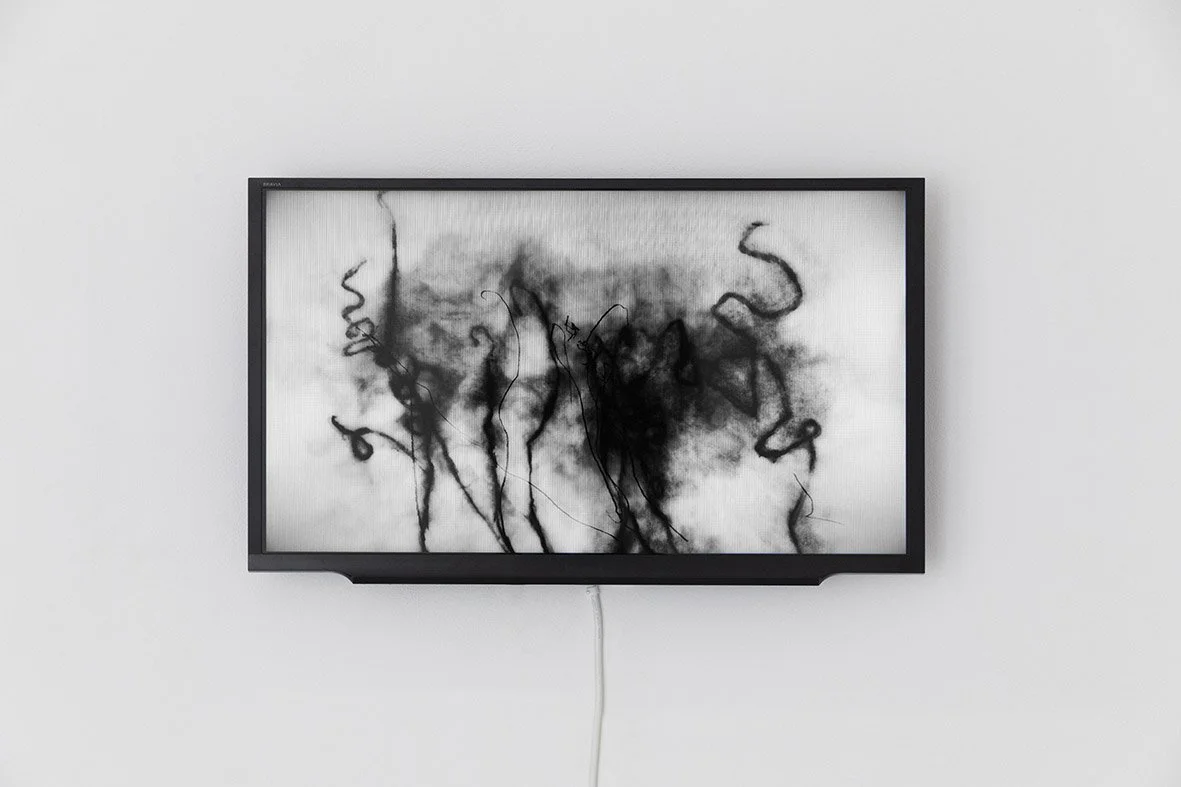
Affective Cartography: Manorhamilton, 2021-2023, stop-motion animation, oil and charcoal, 30secs. ATMOSPHERES 1
The re-visioning of drawing practice imagined by 'Drawing deCentered'
by Sean O'Reilly 2023
'Drawing deCentered' marks a number of critical approaches that challenge drawing's more representational engagements with an already settled world of finished forms. Such a challenge echoes what Paul Klee sees as art's central motivation: 'Art does not reproduce the visible but makes visible.' This powerful credo is, in different ways, incorporated in the work of the group and their attempts to join up, as Tim Ingold suggests, 'with those very forces that bring form into being.' Beyond the exterior surface of materials, objects and landscapes lies an immanent order: a virtual flow of material stirred up by elemental as well as human forces that may be sensed intuitively, mapped technologically or conceived politically as 'atmosphere.' This wider view on what constitutes atmosphere also speaks to the affects, hauntings and movements of matter that entangle subjects and dissipate solidity which, to varying degrees, is overwhelmed by its other-worldly charge. Within an 'atmospheric description' the traces of past, present and future always reveal a story about the movement of things. Haunted landscapes are populated by the assemblages of past lives; of human and non-human relations; of the effects of ecological breakdown. Just as landscapes of the future are eerily haunted by the planning and design imaginaries of major industrialised societies.
Addressing the 'conditions', 'matters' and 'affects' of atmospheres, the artists Felicity Clear, Kiera O'Toole, Wary-Ruth Walsh variously employ the drawn or diagrammatic line to trace the force and movement of materials in the formation of atmospheric environments, landscape and spaces.
'There are lines in the landscape because every landscape is forged in movement, and because this movement leaves material along the manifold paths of its proceeding. To perceive these lines is not to see things as they are but to see the direction along which things are moving.'
Clear's expanded drawing installation invites the spectator to an immersive experience generated from her engagement with the conditions of local weather. Her linear constructions and drawings are generated from live weather data recorded over a 10-week period from a weather station she installed in the town of Manorhamilton. This data allowed Clear to create diagrammatic images that embodied the movement and changing patterns of weather over long periods of time. Using such data, Clear generates two kinds of rhythmic gesture: free flowing cyclical rhythms reflecting the cosmic and vital time of nature, and the linear rhythms of quantified and fragmented time imposed by the schematics of technology. Clear weaves together both types of gesture in a state of collision within the same work, drawing attention to the different ways humans both feel as well as map and conceptualise atmospheres and the invisible conditions that drive their changing states. The weather station was later installed in the gallery window space, providing live data readings of the local weather as it changed.
O'Toole's close attention to feelings, vibrations and bodies of sensation within specific environmental settings forms an open research enquiry into how immanent flows of matter become co-active agents in the formation of the drawing. Through the force of an encounter with the unformed or deforming power of nature, O'Toole's drawings trace correspondences with atmospheric conditions by following the movement and force of materials in the ongoing formation of place. Her itinerant, ambulant and highly charged drawing experiments consist in following vectoral flows across a sensory field, tracing micro-intensities and singularities of matter instead of re-constituting its general form. In the present work her gestures, movements and spontaneous marks are first captured then reassembled within a stop-motion video animation. This visual polyphony was then harnessed by the composer and sound artist Cahill Roche, who used it to generate a new sound work that was interlaced with the video in the final piece. In revealing the forces or intensities that lie behind sensations, O'Toole draws us back to the genetic conditions and movements of matter that first form atmospheres and also create a sense of place.
In her examination of the language of architecture and the built environment, Walsh explores ideas related to planning and design in a critique of what Marc Augé calls 'non-places.' Working with the plastic detritus of consumerism, Walsh studies and works with the affects transmitted by the qualities and linear compositions generated from these materials as she constructs her own drawings and imaginary models of architectural space. Juxtaposing her own future designs with the remnants of vernacular architecture found in the local area, Walsh questions the wisdom and sustainability of such spaces and whether or not they are conducive to an ecological or even desirable future. Whilst modern plastics open up traditional architectural barriers between inside and outside, their own production methods register a more sinister and unsettling affect. Conditioned by their production from crude oil and their longevity and damage to the eco-sphere, plastic packaging is quickly forming part of the Anthropocene stratum. Within Walsh's diagrammatic drawings and models, the image does not function to represent a specific scene but rather constructs a speculative and even dystopian vision of what is yet to come — a new type of reality where traditional co-ordinates are lost within a plastic world of reflection and light. In the words of the artist: 'In ways the work succeeds as it seduces the viewer with light and transparent plastic; on the other hand the work utterly fails as visitors sadly love it.'
Taking us on a journey through matter, movement, weather, atmosphere and surface, the artists within Atmospheres 1 present a philosophical and ecological series of works that interweave bodies, minds, landscapes, topologies and design in a correspondence and movement of lines towards the future. Each artist demonstrates differently that atmosphere is not 'set over against perceivers but co-mingles with, and saturates their consciousness, wherein it is generative of their own capacity to perceive'… and to revision the potential of drawing.

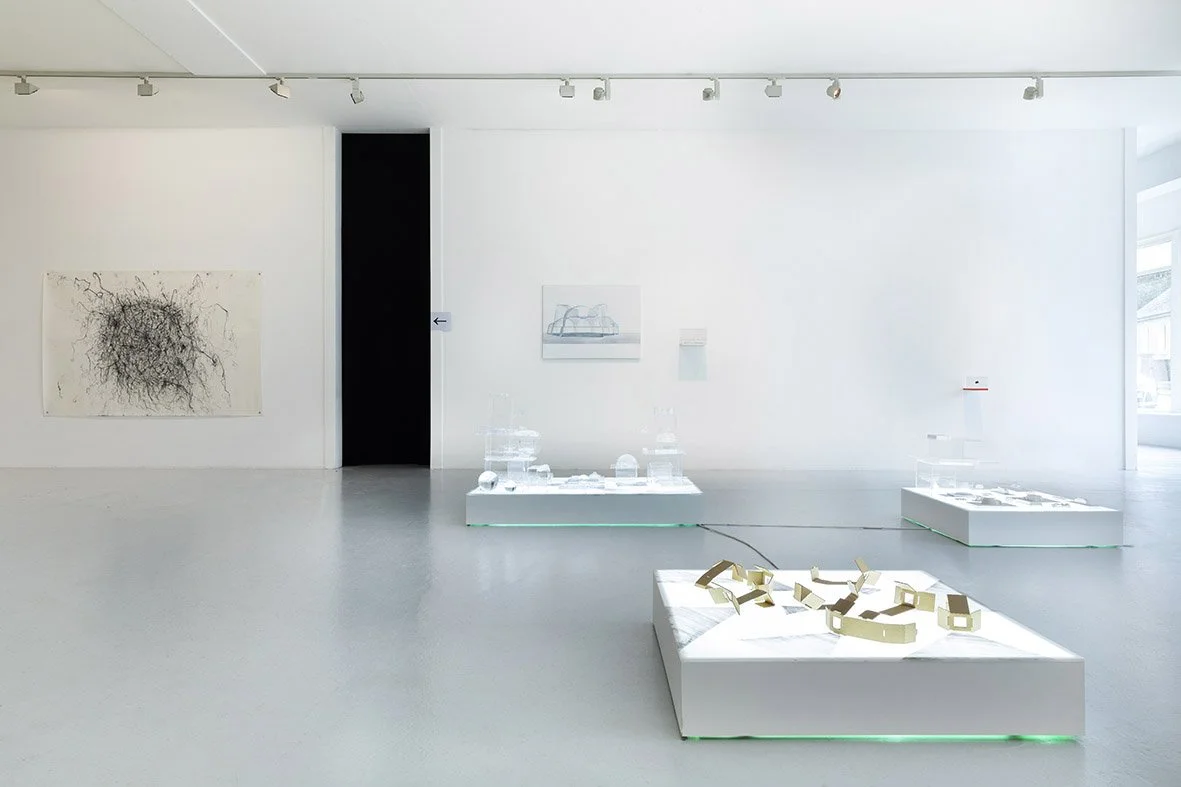
Right to left: Wall: large drawing in charcoal by Kiera O’Toole, Mary-Ruth Walsh, wall: painting and perspex box with found bee. Floor recycled object son light boxes, by Mary-Ruth Walsh
Affective Cartography, Manorhamilton, 2023, oil and charcoal on archival paper. 150cm x 100cm