Affective Cartography: The Way that I Felt, Caves of Keash
The Factory, Sligo, 2021,
Royal Hibernian Academy, Dublin, 2023
Exhibiting Artists:Kiera O’Toole, Tommy Weir, Ruth Le Gear, Christine Mackey, Kate Oram and Sarah Ellen Lundy; along with writer, Julianna Holland and Dr Marion Dowd, archaeologist and leading cave expert.
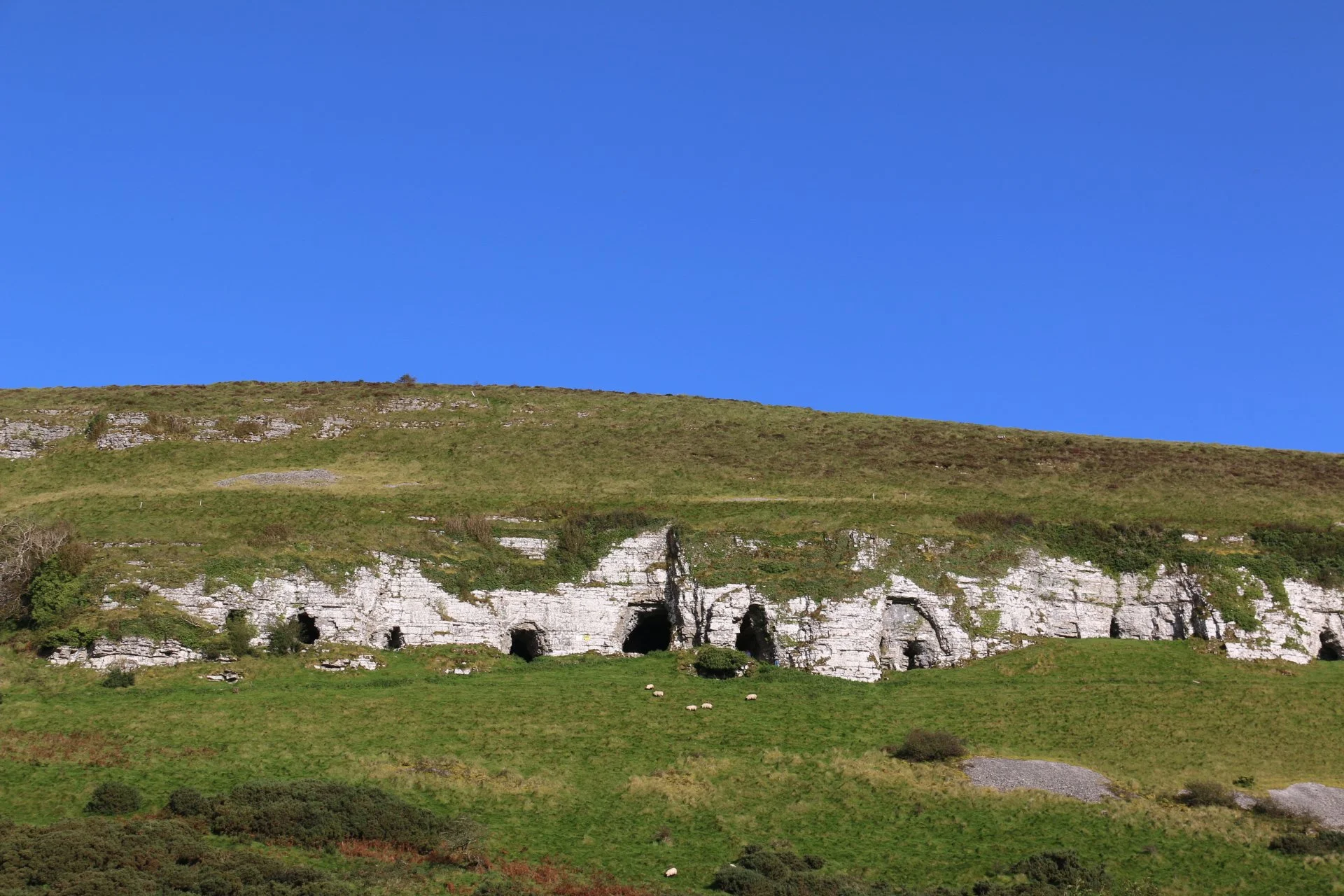
https://www.treadsoftly.ie/walking-keashcorran
Left: Tommy Weir, Right, Kiera O’Toole. Floor installation, Kiera O’Toole. Photography by Tommy WeirWalking Keashcorran
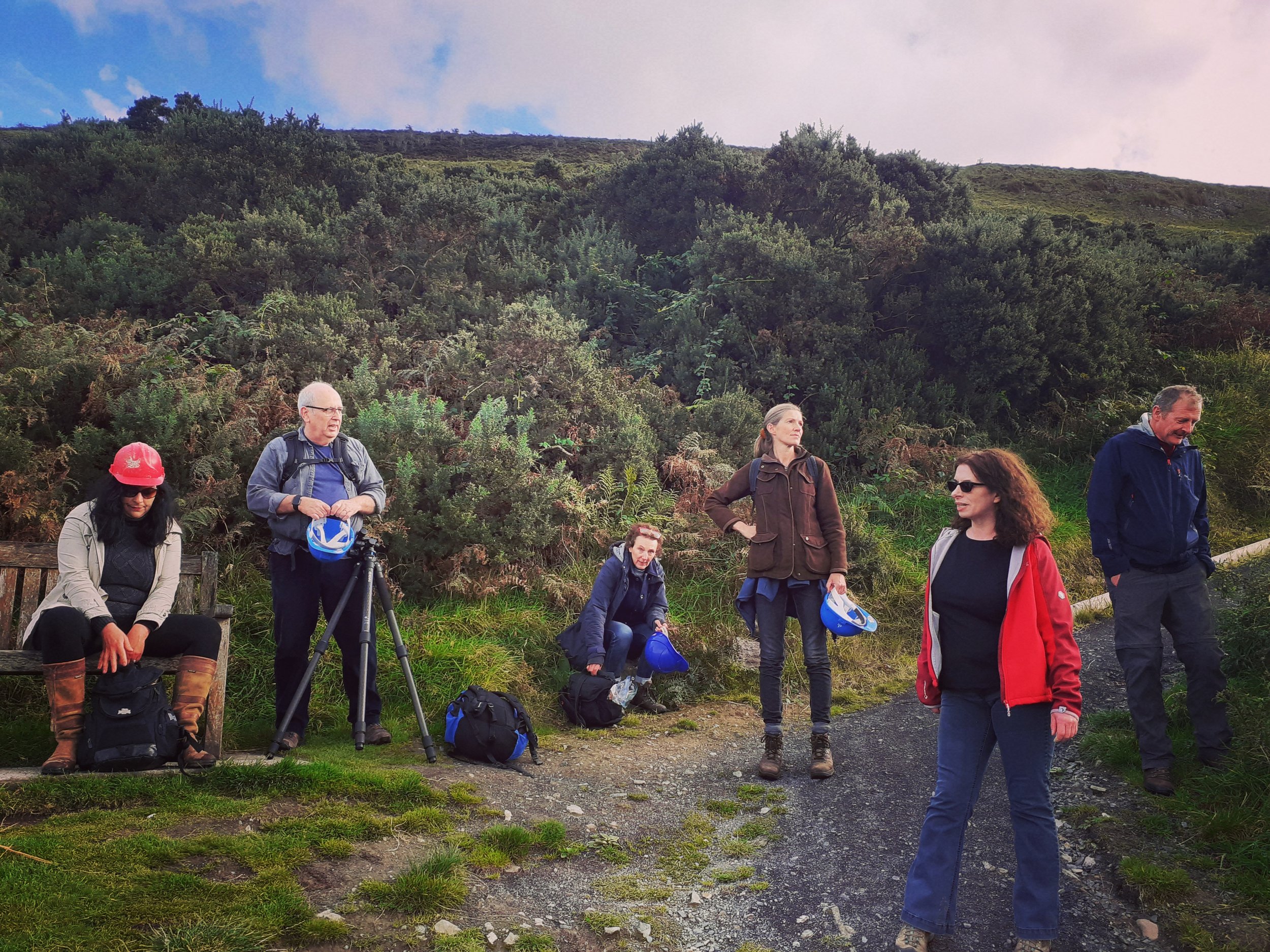
Caves of Keash in the Bricklieve Mountains, Co.Sligo (RMP: SL039-034; NGR: 17060 31215) form the genesis for this collaborative arts project. Through a guided walk led by Dr Marion Dowd, archaeologist and leading cave expert, six arts practitioners; Kiera O’Toole, Tommy Weir, Ruth Le Gear, Christine Mackey, Kate Oram and Sarah Ellen Lundy; along with writer, Julianna Holland from the North West of Ireland explored the cave's history, mythology and human relationships. Caves as primordial sites are often associated with thresholds between realms that are unfixed and unknowing. ‘Walking Keashcorran’ embraces the idea of the threshold for unanticipated visual and conceptual exchanges between the artists and the caves. The project builds upon ‘Walking Bird’s Mountain I & II’.
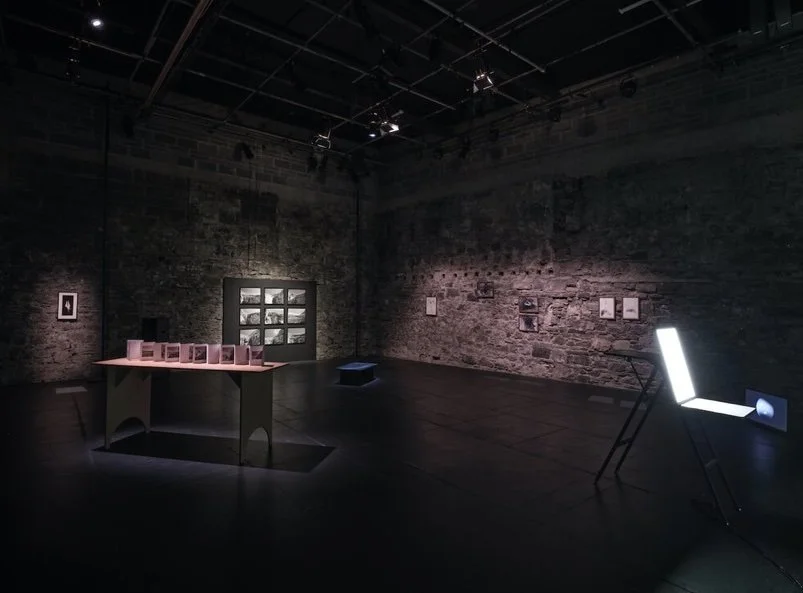
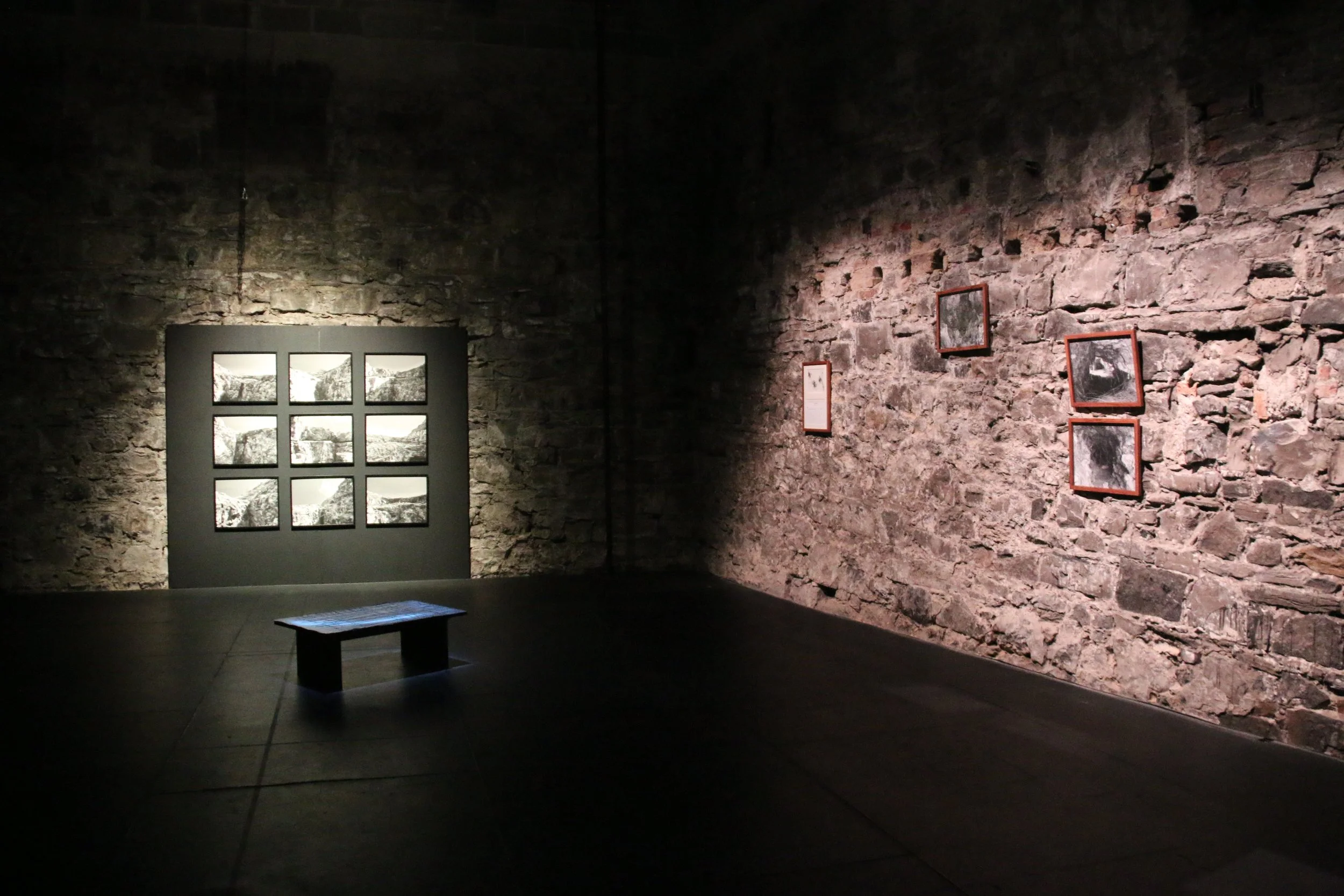
Left to right: Table with book by Tommy Weir and Julianna Holland, Back wall; framed photograph by Kate Oram, Black board with nine images by Tommy Weir, Left Wall: six framed works by Kiera OToole, Left: Installation by Christine Mackey, 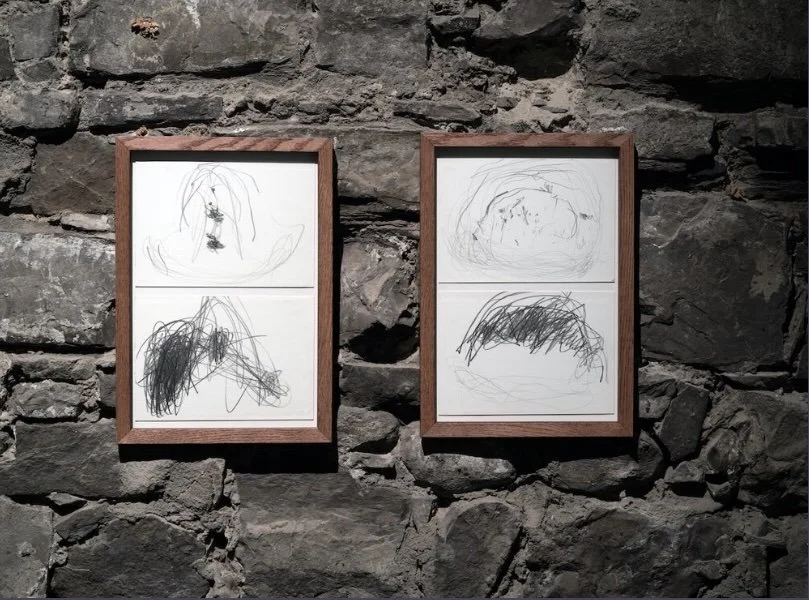
Kiera OToole, Affective Cartography: The Way that I Felt, Caves of Keash, 2021 The Factory, Sligo. Photography by Tommy Weir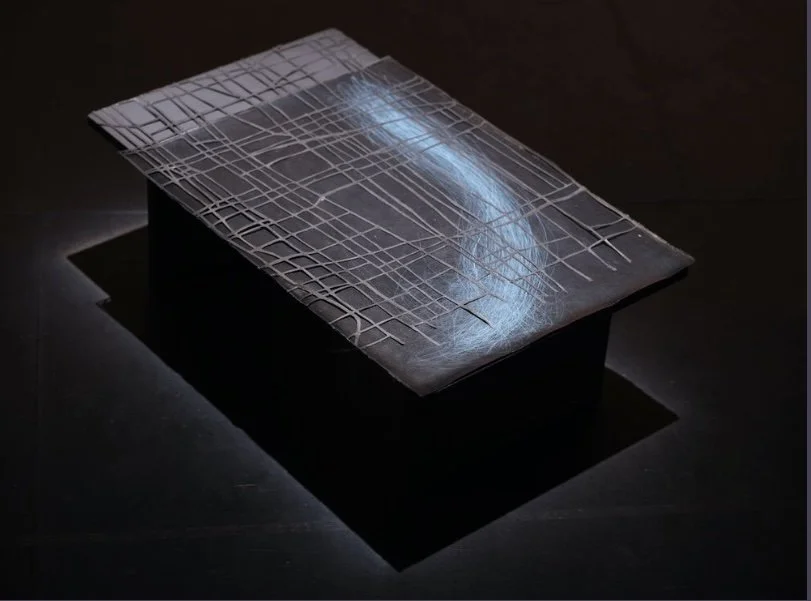
Kiera O’Toole, Affective Cartography: The Way that I Felt, Caves of Keash, 2021 The Factory, Sligo, pencil on paper, collage. 
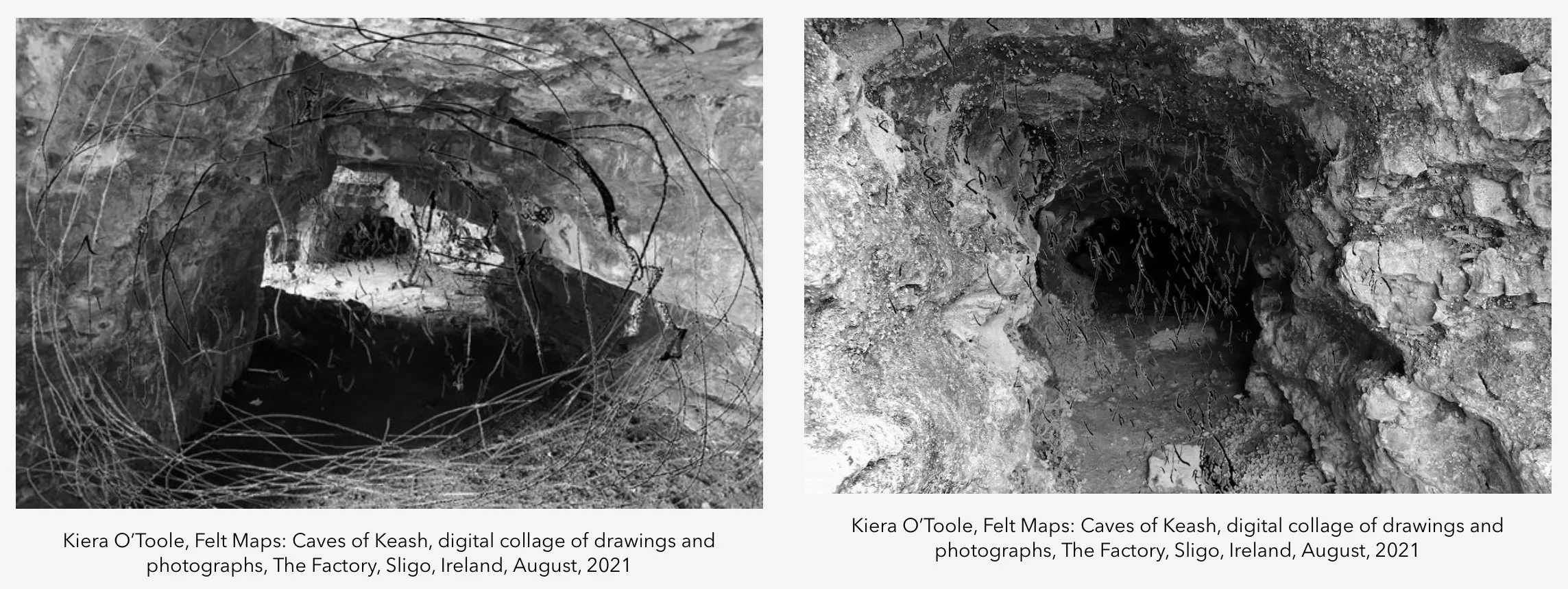
Caves of Keash, Sligo, Northwest Ireland The complex and sometimes rapidly changing emotional states experienced in the
darkness and silence of caves come through in Kiera O’Toole’s felt drawings. Do these feelings ever leave the cave or are they absorbed into the rock? If we feel fear, or awe, or serenity, are these our emotions or those left behind by others? Do different caves evoke different emotions? These questions permeate O’Toole’s imagery.
Dr Marion Dowd, archaeologist and leading cave expert.
Walking Keshcorran: The view from here
by
Dr Marion Dowd, archaeologist and leading cave expert.
Walking Keshcorran documents the responses of seven artists – Julianna Holland, Ruth Le Gear,
Sarah Ellen Lundy, Christine Mackey, Kate Oram, Kiera O’Toole and Tommy Weir – to the Caves of
Keash in south county Sligo, initially visited by the group in October 2020. Seventeen cave entrances
penetrate the white limestone cliffs on the western face of Keshcorran Mountain, the most visually
distinctive caves in Ireland.
Geologically, the caves were formed millions of years ago, long since abandoned by the rivers that
coursed through them, slowly sculpting passages and chambers through solid rock. The valley
beneath the caves was scoured out by massive glaciers that amputated the caves leaving behind the
stubs of what originally had been much longer passages. Archaeological investigations in 1901 led to
the recovery of an eclectic assortment of finds: bones of wolf, Arctic lemming, bear, red deer, seal,
horse, bird, cattle, hare, pig; remnants of hearths that once provided light and heat; bronze pins that
fastened cloaks; bone needles for sewing; an iron saw for carpentry; human teeth as ritual offerings;
an armour-piercing arrowhead; a Viking comb; and a stone axe. Such fragments offer glimpses into
past lives, lives lived hundreds of years ago and thousands of years ago. The ancient biography of
these dark mountain caves is at the core of this exhibition.
The passage of time permeates these works. The caves themselves are testimony to the power,
patience and persistence of a single drop of water across deep time, echoed in the beauty of Ruth Le
Gear’s sound and video installation of droplets within the caves. The hypnotic and rhythmic quality
of Kate Oram’s ‘Drip’ evokes both a sense of timelessness as well as the cyclical nature of time. In
‘Attainable’ she invites us to imagine what is almost unimaginable to the modern mind – a landscape
where humans and their impact have been erased. Julianna Holland travels even further back,
before the caves existed, to the formation of limestone – the ‘withdrawn sea’ and the shells it left
behind. Any conversation on deep time inevitably leads to thoughts of decay. Part of Christine
Mackey’s installation, a chalked drawing of the 1901 cave survey, anticipates erosion. Tommy Weir’s
images capture the slow attrition of the exterior face of the caves as the elements slowly grind away
at the cliff face.
Caves contain. They contain experiences, feelings, events, memories, artefacts, bones, sediments,
the dead. This theme winds powerfully through Holland’s poetry – the ‘stilled wing’, ‘fractured skull’
and ‘nests of hair’. In ‘Things we leave behind’ she infuses the objects that have survived the passage
of time with a human touch, bringing to life the woman, man or child who once held or used or
treasured these artefacts. Weir’s photography reminds us that what can be contained can as easily
be lost. Le Gear references the intangible spiritual dimension of caves. Sarah Ellen Lundy draws us
towards the many teeth and mandibles recovered from the cave sediments, representing scores of
long-dead creatures disintegrating until they eventually become part of the cave body itself.
Absences and voids are found here too. The seeming emptiness of caves can invoke intense
emotional responses ranging from anxiety to fear to serenity. But are these caverns as empty as they
first appear? The complex and sometimes rapidly changing emotional states experienced in the
darkness and silence of caves come through in Kiera O’Toole’s felt drawings. Do these feelings ever
leave the cave or are they absorbed into the rock? If we feel fear, or awe, or serenity, are these our emotions or those left behind by others? Do different caves evoke different emotions? These
questions permeate O’Toole’s imagery.
Medieval scribes scratched onto vellum the supernatural nature of the Caves of Keash. Manuscripts
recount sagas of omnipotent women of the Tuatha Dé Danann who entrapped the Fianna in the
caves with magical yarn. The forge of the one-footed one-eyed master smith Lon Mac Liomtha lay
deep inside the caves where magical weapons were wrought. And the infant high king Cormac Mac
Airt was reared by a wolf in the most inaccessible cave for the first seven years of his life. This
exhibition captures some of that otherworldliness. Lundy’s striking film work narrates the ancient
knowledge to be found in deep, dark, silent places where the experience of the elders survives. Pre-
industrial cultures frequently gendered this wisdom as feminine, as Lundy does here, a wisdom
without words. She draws together the core elements that make us whole human beings, if we
would only listen.
Across many world cultures, caves are closely associated with the concept of threshold, dark spaces
located betwixt and between that lead from one world to the next. This sense of liminality and the
tenuous boundary between light and dark confront us in Weir’s images. What is particularly striking
is the disorientating focus on the boundary between cave roof and the heavens above. Our gaze is
drawn upwards rather than the usual outwards or inwards perspective. He captures the fragile
crumbling nature of the fractured cave edges, at once both vulnerable and threatening, mirroring
the dual tension of how it often feels to be in a cave. Beauty resides here too, in the symmetry of
Weir’s photographs; Holland’s poems folding in on one another accordion-like; the soothing ring of
Oram’s droplets; Le Gear’s orb in delicate suspension; the orderliness of Mackey’s listings; Lundy’s
wild shaman; and O’Toole’s blue.
The voices of others whisper through this exhibition. Holland beckons us towards the newborn
infant Cormac, sleeping snug with his lupine siblings in the cave, decades before his reign as high
king of Ireland. Lundy conjures the powerful supernatural woman, protagonist of medieval myth and
recent folktales about the caves. O’Toole invokes Robert Lloyd Praeger, foremost Irish naturalist of
the early twentieth century, who had an intimate familiarity with and love of the Sligo landscape.
Mackey honours the ground-breaking work of the gentlemen scholars who investigated the caves
with great diligence 120 years ago.
The Caves of Keash have attracted almost two centuries of scientific enquiry, enquiry that continues
to thread through the exhibition in the form of Kate Oram’s meditations of the physics of deep time;
Ruth Le Gear’s contemplation of the gentle but persistent forces of hydrology; Christine Mackey’s
observations on ornithology and conservation; Julianna Holland’s anthropological sensibilities;
Tommy Weir’s play on the physics of light and dark; Sarah Ellen Lundy’s exploration of the
relationship between anatomy and geomorphology; and Kiera O’Toole’s study on emotion and
phenomenology. In 1901, Edwin Tulley Newton painstakingly identified the avian bones from the
caves. Twelve decades later, Mackey’s installation illuminates those species that are now
endangered – some bird names now sadly foreign to our ears. Her shared-horizon photograph
juxtaposed with Robert Welch’s glass lantern image from 1901 emphasises the constancy of the
caves as they bear witness to the drastic environmental changes of the past century.The Factory in the heart of urban Sligo provides a sympathetic setting for this exhibition. Entering
through the narrow doorway, the visitor leaves the world of daylight, travels through a dimly lit
passageway, through another constricted opening, then into a spacious darkened chamber. Shadow
abounds, sound echoes. Crumbling plaster and exposed brickwork resemble the eroded limestone
beds that encase the Keash Caves. There is little colour; this is a palette of black, grey and white. It
takes time to adjust to the space, to orientate. The visitor needs to seek out the installations and
images. Artworks become artefacts: some will preserve, some will decay, some will be lost, some will
be curated.
Each of us will take something different from this exhibition. As a cave archaeologist, what
particularly fascinates me is the diversity of voices, the diversity of approaches and the diversity of
responses. Yet this should come as no surprise. We know that animals and people have engaged
with the Keash Caves in myriad different ways over the past twenty thousand years. There is no one
story, no single understanding. Some of the artists initially experienced the Keash Caves as a difficult
subject. This surprised me, considering the rich natural and cultural legacy embodied within these
mountain chambers. On reflection, however, their struggle chimed with the nature of human
relationships with the subterranean. Caves are never easy places to navigate – whether physically,
emotionally or psychologically. Caves take time. These seven artists took the time. For this, we can
be grateful.
Marion Dowd