Affective Cartography: Altona, Hamburg, Germany 2024-2025
‘Drawing ATMOSPHERES III’ DAS ESSZIMMER, Bonn, Germany
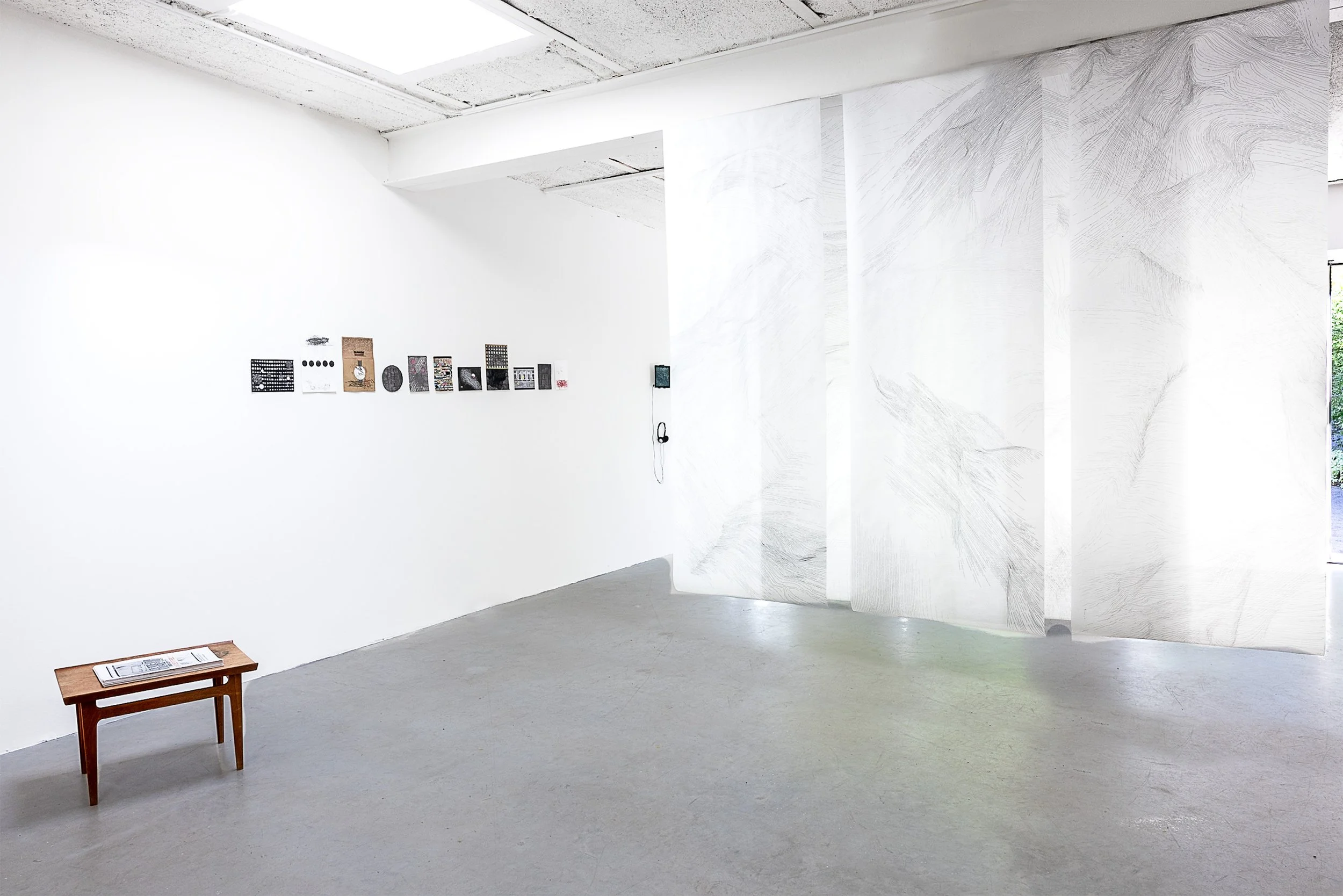

Left to Right: Kiera OToole, Affective Cartography: Altona I, Das Ezzimmer, Bonn, Germany 2024-2025, newspaper on table, series of collages on walll. Left: Felicity Clear 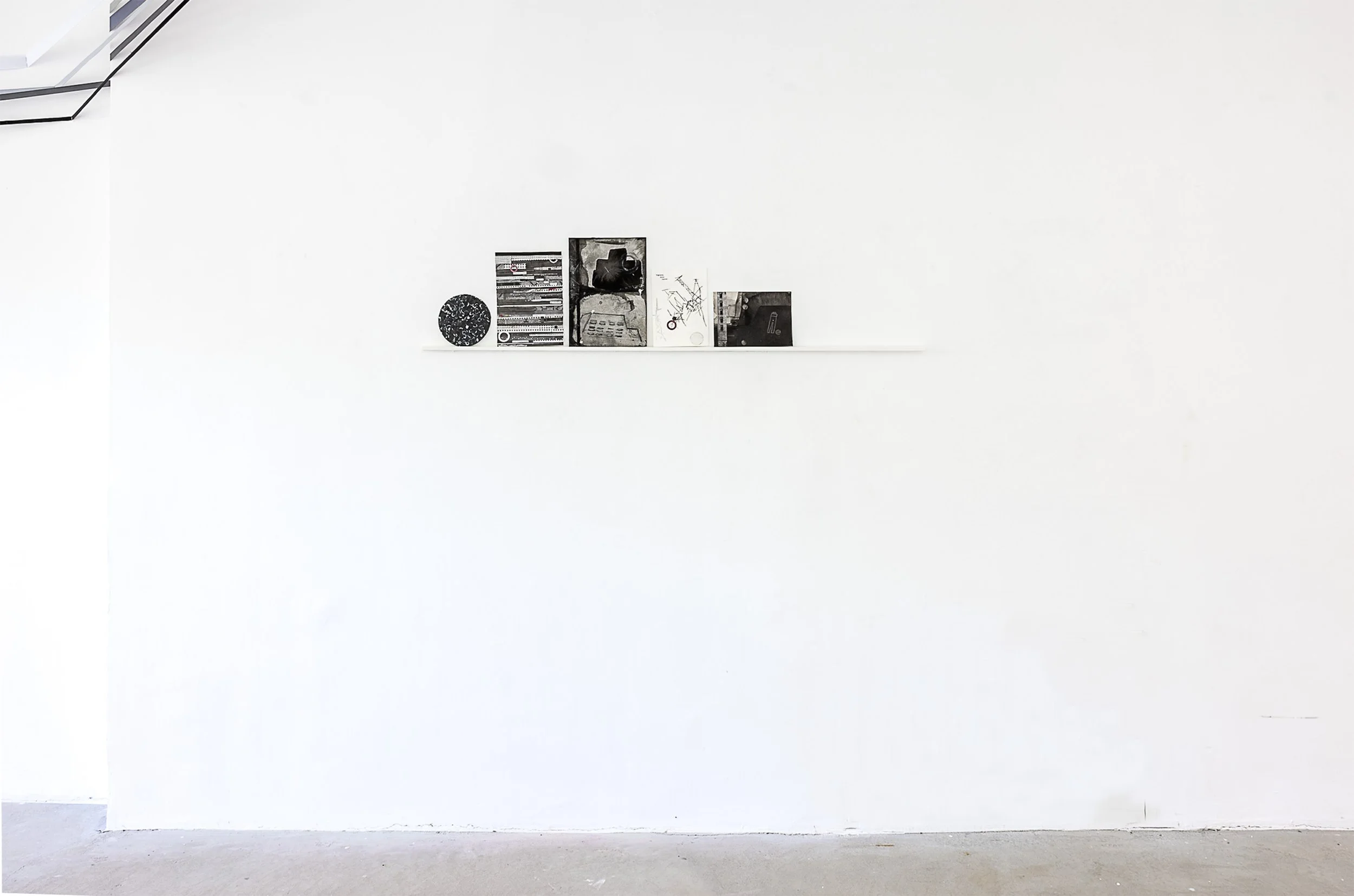
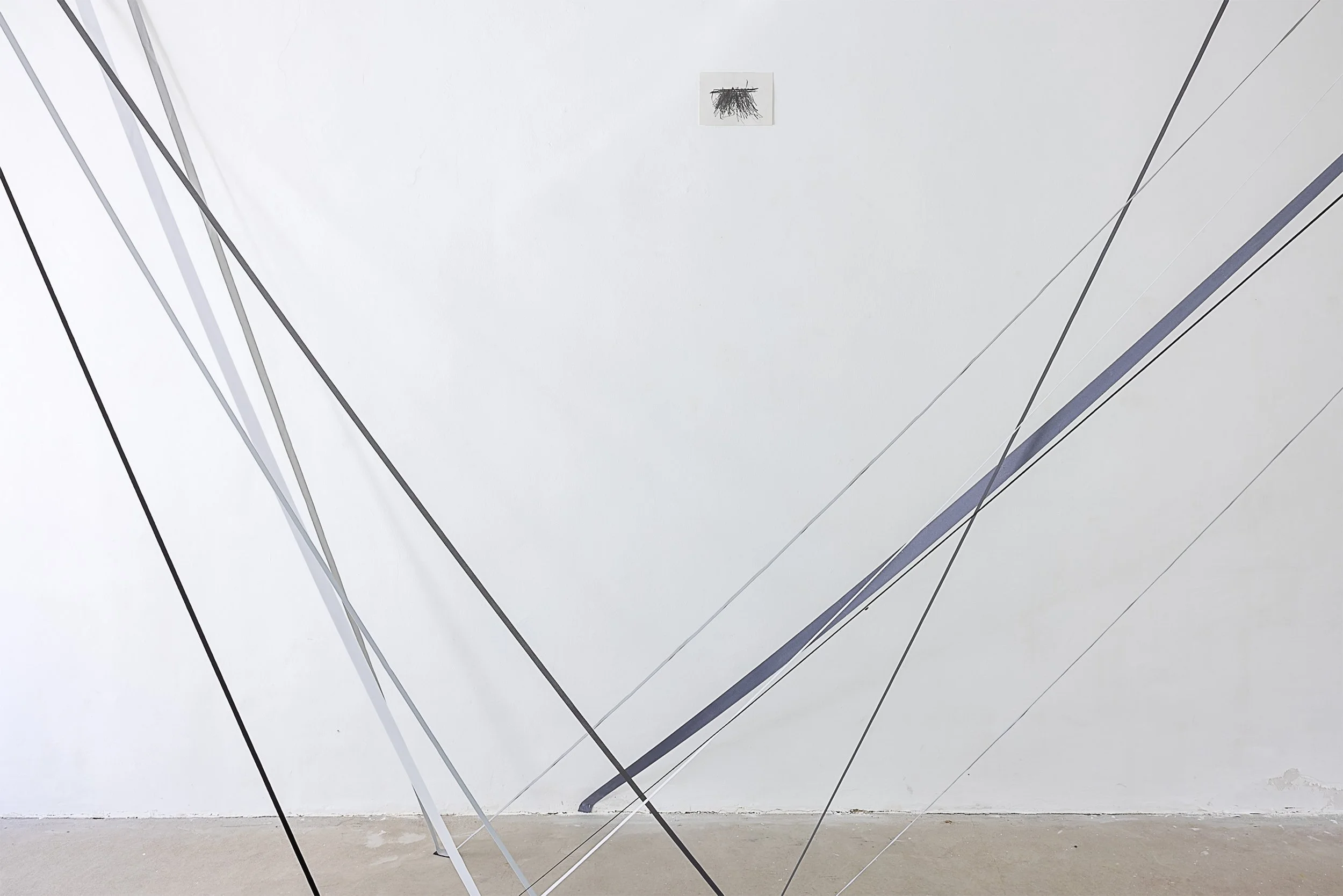
Front to Back: Felicity Clear, elastic; Kiera OToole, Affective Cartography: Altona I, Das Ezzimmer, Bonn, Germany 2024-2025Conversation between Sibylle Feucht and Felicity Clear (FC), Kiera O'Toole (KOT), Mary-Ruth Walsh (MRW)
SF: The title of your group show — Condition, Matter, Affect: ATMOSPHERES II — sounds a bit like a manifesto and makes clear that it is part of a row of different group shows that you see as a connected body. Could you maybe tell a bit more how for you Condition, Matter and Affect connect to each other and how they form together ATMOSPHERES?
MRW: Yes, it is a manifesto of sorts. It evolved through many conversations, realising that these associations already existed in our practices. Each of the exhibitions are site-specific, whether it was Leitrim in Ireland, Bonn or Hamburg in Germany.
FC: For example, in my case, I secured my portable weather station to the gallery building in Leitrim to record the local weather data. Then I repeated the same process in the gallery courtyard in DAS ESSZIMMER. My work reflects on the 'conditions' of the meteorological atmosphere using data taken from my live weather station located at street level, as well as other data from internet sources. I reinterpret this data into line installations and drawings on paper. I never know how my 3D drawing installations are going to look because they are made in-situ. This is a nerve-wracking process but it's also exciting and challenging.
MRW: I, too, use a range of drawing media including film, installation, water-based painting and collage to investigate the complex relationships between real spaces and their representations. I explore the concept of matter through the lens of architecture and the built environment, investigating how these physical spaces interact with the human experience. I'm exploring the context of the built space by pushing the boundaries between the tangible and the imagined.
KOT: My approach to space is not something imagined but it is more similar with Felicity's approach in that I record information. I do this through drawing, experimental animations and collages. However, how I record this information is through my felt-body rather than using electrical apparatuses. Through my felt-body, which acts as a sounding board for the affective and expressive qualities of atmospheres, I record the spatialised feelings of everyday spaces. This atmospheric affectivity is felt as a bodily impulse that directly influences the gestural drawing process in-situ. The drawings, termed felt maps, are records of my pathic phenomenological experience of a space and in this way, this process is a more holistic understanding of the spaces we inhabit.
SF: Thanks for your atmospheric responses. Where you all seem to meet is connecting line and space, translating space into lines as well as expanding lines into space. Would you agree on that?
MRW: Yes, absolutely. I agree with that observation. This idea of translating and expanding lines is particularly important in the context of ATMOSPHERES. Each of our practices brings a different approach to how we experience and represent the atmosphere of a space — whether through weather data, architectural form, or felt-bodily sensation — but ultimately, we all share a commitment to exploring ideas of how space, matter, and affect intersect. So yes, I do think we're all meeting at this juncture of line and space, using it as a tool to both define and dissolve boundaries, to map conditions, and to express the emotional and psychological resonances that emerge from the spaces we inhabit.
For me, line and space are inseparable in the way we experience and represent our environments. However, they also act in separate ways in my practice. Line is not only a visual element, but it functions to articulate the relationship between matter — whether that's the physical form of architecture or the intangible qualities of space.
FC: Line and space are very important in my work as I am drawing links between lines used in meteorological diagrams and lines used to describe the same conditions and airflows in a more experiential way. Kiera introduced me to the British writer and professor of social anthropology, Tim Ingold, whose books about line were an influence while I was making this work; line as it exists in the world as well as line in art. I think Catherine De Zegher's and Cornelia Butler's book On Line is also influential on us. One of the advantages of being in a collective is that we can share and discuss sources and texts.
KOT: The relationship between line and space is fundamental in my practice, however, there is no attempt to describe space through line but rather, how line records the 'spatialised feelings' of space. A line is an extension of movement of both the gesture of the body and the gesture of space that simultaneously co-exist and affect each other. I'm interested in this interplay between how lines can record and hold space, and how space can be transformed into something that can be traced, touched, felt, and experienced. The gestural line becomes a form of pathic knowing, revealing dimensions of spaces that are more felt than thought.
SF: In art I have the impression that drawings and with it the "line" are often viewed as the small brother/sister of painting… as something that comes before the real thing… Despite the fact that drawing, or better carving a line is probably the first act of abstraction, enabling us to (re-)construct the world. I also recall that the foundation of Drawing deCentered was a reaction to the fact that there is no institution in Ireland so far dedicating itself solely to the line.
KOT: I think the familiar practice of making a mark, or tracing a line has arguably, since the cave drawings, constructed and interpreted the world. The line belongs to more than the art world, it is a fundamental act of being human, it's a way of making sense of the world. It is an experience first and foremost.
FC: With most kinds of line drawing you are also very close to the person who made the drawing, even if there are thousands of years between you and the drawing artefact. It can feel like mark making hasn't changed that much since the first drawings that we know. Line can also be remarkably varied in its possible applications; it can describe an object, a complex idea such as in diagrams, or a feeling.
I think since the 1990s drawing has largely lost its second-class status, although that said, in private galleries you still see a lot more painting and other media than drawing. Hence, our desire to continue to raise the profile of drawing.
KOT: Drawing deCentered was founded as a response to Ireland's lack of a dedicated drawing institution. Our aim is to raise the profile of contemporary drawing and explore drawing as an experimental and expanded field. However, Drawing deCentered does not have a physical space at present so we work from the peripheries as well as the inside and outside of the white cube.
MRW: You mention line enabling us to (re-)construct our world, yet I think line allows us to deconstruct and then reconstruct our world as a way to make sense of the world we live in. Line is so nimble, mobile and available, it has the ability to be descriptive, informative, emotional, sensory and so on. However, regarding it being the 'smaller sibling' of painting, they are two very different mediums, yet they can complement each other too. We felt that drawing was so important we wanted to give it more space and that's how Drawing deCentered came about.
SF: Since the exhibition Condition, Matter, Affect: ATMOSPHERES II is part of a series of exhibitions that are also an outcome of a residency, where site-specific works have been developed… maybe you could share your experiences from this residency collaboration with a somewhat open outcome and how the immersion into different contexts influences your individual works but also the collaboration among you.
MRW: As an artist, immersing myself into a new environment is important because it reignites my perception and keeps me open to new ideas. Personally, a highlight of this exhibition was my engagement with water-based painting and creating my first wall drawing. This happened during a discussion, or perhaps better described as a challenge put to me by Sibylle Feucht — why not do a wall drawing? This wall drawing is a good fit within my practice and one of my paintings was 'framed' within this wall drawing. Since then, I've completed another wall drawing, this time in wool which allowed a more 3D approach, better describing my intentions.
KOT: Although our practices differ, they rub up against each other and thereby challenge and highlight aspects of our individual and collective practices. These new perspectives arise in ways that wouldn't otherwise occur. At FRISE in Hamburg, DAS ESSZIMMER in Bonn and in Leitrim Sculpture Centre in Ireland, I approached each residency with openness and a site-specific perspective, both of which are central to my practice. At the same time, my current practice-based research informs the work.
FC: First of all, a residency provides me with time to concentrate on my practice alone in a very focused way. I was in Bonn for a few weeks before the exhibition which gave me time to get to know both the space and place. I think we all prefer something more discursive with a project. It's important to have time for conversations with curators, gallery staff, and other artists and to hopefully develop more sustained long-term relationships.
MRW: Ultimately, the connected body of exhibitions, ATMOSPHERES I, II and III, questions how the seen and unseen elements in the human and non-human relationships pervade the spaces we inhabit and also our emotional and psychological states.
Intertwining Drawing and Philosophy: An Interview with Visual Artist Kiera O'Toole
DiSp: Kiera, can you explain the concept of Drawing In-Space and how it influences your artistic practice?
KOT: Absolutely. Drawing In-Space is a methodology I developed through practice-based research. It originated from a drawing experience in 2016 when I organised and led a local drawing group called the Coolaney Drawing Project. We drew in situ, focusing on the rich material culture such as a castle, derelict mill and a famine village in and around the village of Coolaney Sligo, Northwest Ireland. On one occasion, I invited the group to draw whatever caught their attention without using their sight perception. An unusual drawing approach for the group. After a minute of drawing, I was surprised to find that not only had we drawn the same quasi-thing* — a specific dripping sound — but we had drawn it in the same manner. I queried how could this be? What influenced us to draw in this particular way, despite our diverse backgrounds (artist, social media expert, photographer, science lecturer). I realised that this experience was predominantly an immediate, pervasive, felt-bodily sense that I couldn't quantify or precisely identify. It stirred something beyond the five senses, towards something more felt than thought. This raised the question: is it possible for gestural drawing to record and document this experience?
DiSp: How do you perceive and record the 'spatialised feelings' of various atmospheres in your work?
KOT: Recording 'spatialised feelings' involves immersing myself in the space and becoming attuned to its atmosphere. I engage in a mediative, pathic* listening, which requires an attitude of openness and surrender to whatever may emerge in my awareness (Griffero 2020, vii). Aligning with the German philosopher Martin Heidegger's concept of listening by 'abstracting' oneself from things (Heidegger 1977a: 156), I consciously shift my attention to what seems to outwards then gradually transitioning inwards to a felt sense. I begin the drawing in-situ process using pencil on paper, my hand hovering above the drawing surface as I seek a connection — a synchronicity between the gestural mark and my felt-bodily sense, even if I can't identify it in the moment. I pay attention to the gestural movements of my hand, whether it moves slowly, twists awkwardly or flicks. Instead of manipulating the pencil, I follow my hand's gesture, attempting to describe the experience through gestural lines. The hand is a gestural instrument capable of expressing meaningful lines and marks with dexterous accuracy, responding to the atmospheric impulses experienced by the felt body. Yet it is not an automatic act; rather it signifies an ability to let oneself go, paying attention to the sensations experienced by my felt body (Griffero 2017, viii).
DiSp: You mention the term 'pathic'. How does this concept integrate into your work?
KOT: Pathic refers to the 'affective involvement' where one is 'subject to' the experiences rather than controlling them (Griffero 2020). It's about letting go and being open to what happens to us. It is not about how a space feels to me but how it feels though me. In other words, it's not how I perceive a space but how a space is perceived through me. In my research, I draw upon drawing and phenomenological research and the theory of atmospheres within new phenomenology to articulate these spaces. Instead of considering them as mere backgrounds or environments, I view them as spaces infused with 'spatialised feelings' that deeply affect our lived experiences.
DiSp: Drawing In-Space highlights the concept of atmospheres. How would you define atmospheres, and what role do they play in your work?
KOT: We are always and already in atmospheres. Atmospheres are nebulous and intangible spaces infused with 'spatialised feelings' and they affect and determine our everyday experiences. Reflect upon the emotional affect of a hospital waiting room, thick with anxiety and anticipation, or the calmness of a vast landscape. By capturing these emotional vibrations, I aim to document the profound, often subtle, impacts of these atmospheres on our lived experiences.
DiSp: Can you elaborate on the concept of 'subjectivity' in your work and how it influences your perception of spatial feelings?
KOT: Subjectivity in my work is about breaking down the perceived duality between internal emotions and external environments. Drawing from German philosopher Herman Schmitz's perspective, subjectivity involves the pre-reflective and affective involvement of someone who is deeply intertwined with 'spatialised feelings', experienced not just as internal states but as atmospheres that permeate the lived and felt body (Schmitz 2019). So I can say that subjectivity, regulated through my felt body, is formed and transformed through the very act of drawing itself and thereby revealing my being-in-the-world.
DiSp: The idea of gestural line drawing is central to your practice. Tell me more.
KOT: Gestural line drawing embodies an impulsivity — a fusion of action and force that cannot be entirely separated. This line is not an inert thing but an active energy that traces the movement of the drawing hand as an extension of the body. It represents a relational force, influencing and being influenced by the atmospheric conditions experienced by the felt body. Within my drawing process, I search for something — an unnamed line; a line that can't be identified in the moment, unlike the line for the sound of a bee, or of the sound of water, or the movement of the trees, grass, plants as the wind blows through it. It is a stirring line that traces outwards onto the drawing surface.
DiSp: Can you tell us about the specific sites you've drawn and how they influenced your research?
KOT: Over the past three years, I've drawn in various atmospheres, ranging from the streets of New York City to the Neolithic caves in Northwest Ireland, the Australian countryside, and currently in Bonn and Hamburg, Germany. The diverse range of sites allows for a richer and more meaningful account in my ongoing Drawing In-Space research project.
DiSp: What do you hope viewers take away from experiencing your 'felt-maps'?
KOT: For me, drawing expresses our fundamental relationship to ourselves and to our world. It is a means of perceiving the emotional aspects of our lived experience. This is why I developed the methodology of Drawing in-Space, to allow us to be present to who we are and where we are, so that we have a deeper understanding of how the 'spatialised feelings' of everyday atmospheres shape our perceptions of our world in a more holistic manner.
DiSp: How do you see your work evolving in the future, especially in the context of Drawing In-Space?
KOT: I will continue to document different types of spaces and atmospheres, perhaps even collaborating with other artists and disciplines to further understand and document these 'spatialised feelings'. Ultimately, my goal is to keep exploring and documenting through drawing, collage, experimental animations, how we perceive and engage with our world, strengthening a more profound and holistic relationship between ourselves and the spaces we inhabit.
Kiera OToole, Affective Cartography: Altona I, Das Ezzimmer, Bonn, Germany 2024-2025, series of collages on wall plinthIrish artists @felicity_clear_art, @maryruthwalshand @kiera_otoole_artist, from the Irish collective @drawing_decentered.
With special thanks to Zeitgeist Irland 24 - a joint initiative of @cultureireland and Embassy of Ireland in Germany
21st February - 3rd March 2025
Zeitgeist Irland 24 is a joint initiative of@cultureireland and Embassy of Ireland in Germany@irlembberlin, #zeitgeistirland24